From the essay “Dealing with a stray dog” by Akira Hasegawa comes a first-hand account, by Daido Moriyama himself, of how this photo was taken:
The photograph first appeared as a single image within the seriesNanika he no Tabi (En Route to Something) in the March 1971 issue of Asahi Camera. As Moriyama himself recalls, “right after New Year 1971, I took a picture of a stray dog in Misawa up north in Aomori where there was a US military base. I was heading out in the morning with my camera in hand and took one step out of the hotel, when right there in front of me was this stray dog wandering around sunning himself. Just like that I pointed my lens at the stray dog and clicked the shutter a few times; later on, his moment in the light was printed as a full spread for a photo magazine series I was doing at the time”. As simple as that. Yet, now that same photograph “catches the eye of photography fans and somehow remains a favourite in Japan and around the world. It’s become a print that wanders around between museums and galleries and private collectors” (from an Asahi Shimbun newspaper essay by Moriyama). A turn of events the young photographer could never have imagined. (the essay “Dealing with a stray dog” is published in the bookThe World through My Eyes by Daido Moriyama, Milano: Skira, 2010, p. 17)
In 1999, fellow photographer Leo Rubinfien wrote an exhaustive essay on Moriyama’s work for the Art in America magazine. What’s especially interesting about this essay is that it provides us with a good explanation of the symbolic of the “stray dog” both for postwar Japanese culture and for Daido Moriyama (in an argument divergent from Kazuo Nishii’s comment quoted above):
Since the Second World War, the image of the stray dog has wandered into Japan’s best art often enough to have us ask what, in that famously rule-bound, rank-conscious land, such a pariah might mean. As nearly as I can tell, its earliest appearance was in Akira Kurosawa’s 1949 film Stray Dog, where it was not a character but the metaphorical name for a young, murderous pickpocket, demobilized from the Emperor’s army into the bomb-blasted city with no home to return to. At the start of the chase, the stern senior detective warns that such mined men am stray dogs, to be put down before they turn into mad dogs, but his despondent acolyte pleads for compassion, recalling that in the chaos of 1945 he might easily have become such a dog himself. The stray is there again in Susumu Hani’s exquisite She and He (1960), this time as the companion of a pathetic ragpicker who is one of the two principals of the story. The dog is pretty much this outcast’s alter ego, and when at the film’s denouement it is hideously tortured by the children of a cell-block town of materialistic salary-men, the man suffers equally, and we with him. […]
For Moriyama to identify himself with these beasts is remarkable. The West maintains a pantheon of alienated heroes, and in its romantic modernist tradition, the bohemian, rebel, tramp or hollow-hearted etranger have been thought bearers of authenticity and moral legitimacy. But in Japan an outsider is truly an outsider. The hero-outcasts of its premodern folklore, the dispossessed lord Yoshitsune, for example, or the 47 vengeful ronin, are not so much opponents of society as plaintiffs for a justice that society has refused but could easily give. The true renegade–with no home village, no pedigree, no uncles or cousins to protect him, no company, guild, obligations, diploma or calling card–is suspicious even to the most free-thinking Japanese. In the less liberal he provokes revulsion and anger. (“Daido Moriyama: Investigations of a Dog” by Leo Rubinfien, originally published in Art in America, October, 1999)
In Phaidon’s monograph simply titled Daido Moriyama, this photo is reproduced on page 55. The author, Kazuo Nishii, proposes the following explanation on the opposite page:
Two versions of this picture exist, printed with the dog facing in opposite directions. Moriyama went to Misawa in New Year 1971 and observred that it had much in common with many base towns, with its øbarbers, cabarets, boutiques, beauticians and oculits… all lined up” and “dogs everywhere”. Urban dogs were often featured in postwar European photography, fighting and snarling, symbolizing animality. Moriyama’s dog, on the other hand, seems to have been taken from a kindred dog’s-eye point of view, as if merely encountered rather than elevated into a symbolic order. (New York: Phaidon, [2001] 2012, p. 54).
About Daido Moriyama:
Born in Ikeda, Osaka, Daidō Moriyama studied photography under Takeji Iwamiya before moving to Tokyo in 1961 to work as an assistant to Eikoh Hosoe. He produced a collection of photographs, Nippon gekijō shashinchō, which showed the darker sides of urban life and the less-seen parts of cities. In them, he attempted to show how life in certain areas was being left behind the other industrialised parts. Though not exclusively, Moriyama predominantly takes high contrast, grainy, black and white photographs within the Shinjuku area of Tokyo, often shot from odd angles.
Moriyama’s photography has been influenced by Seiryū Inoue, Shōmei Tōmatsu, William Klein, Andy Warhol, Eikoh Hosoe, the Japanese writer Yukio Mishima and Jack Kerouac’s On the Road. Moriyama has written a memoir titled Memories of a Dog. (Wikipedia)
When the words dog and art appear in the same sentence, rest assured that at least someone will think of Jeff Koons and his sculptures. It’s amazing how easily he appropriated something so widespread and innocent as a domestic animal. But what about other genres – painting for example? Although the technique was proclaimed dead by Paul Delaroche in 1839, practice proves him wrong, and there are plenty of painters from the 20th and the 21st century, who obviously couldn’t resist making a portrait of at least one dog. Pets, non-pets, puppies or hounds, man’s best friends seem to be a remarkable subject of representation. Dogs are what they are – wolf-like animals, which were the first to be domesticated by humans. However, this long history of a relationship between men and dogs has preconditioned human society and individuals to view dogs as their friendly companions. For many people, a dog (especially their own dog) is more than just an animal. Our pets easily become part of our family. Although idiosyncratic and eccentric by default, artists are no exception here. There are lots of artists who were known for special relationships with their dogs – Andy Warhol and Archie, Picasso and Lump, David Hockney and Stanley and Boodgie (to name a popular few). So let us delve into the traits and the symbolic meaning of a dog, as seen through the eyes of 10 influential artists from the 20th century.
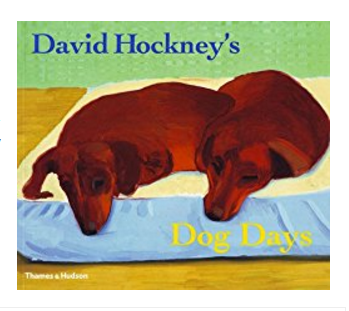
Editors’ Tip: David Hockney’s Dog Days
The book is a delightful collection of David Hockney’s paintings, in which he represented the two of his dachshunds. Since “dogs are not very interested in art”, as Hockney says, these paintings come as a result of both sharp observation and affection, followed by lyrical studies in form and design A text by the artist is included, and it gives a behind-the-scenes glimpse of how to work with models that don’t necessarily want to sit still. The book contains 84 color illustrations.
David Hockney - Dog Days
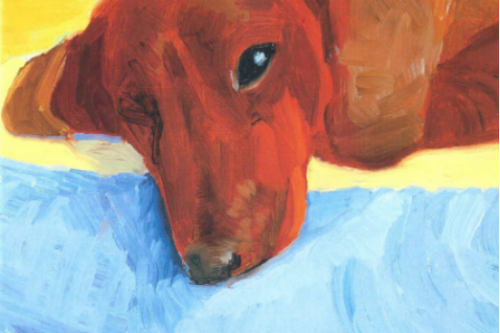
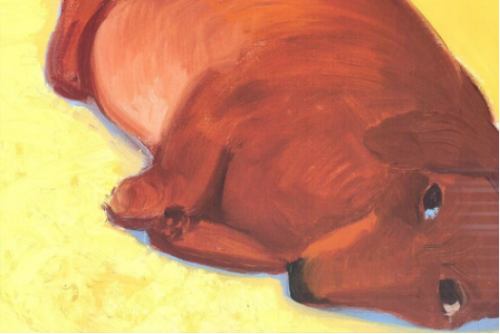
You may have noticed that David Hockney was mentioned more than once in this article. During the ’90s, one of Britain’s best-known and most admired painters went through a phase of a certain fascination with his dachshunds. From September 1993, all he did was painting and drawing his dogs. This, naturally, resulted in a collection of remarkably warm, endearing paintings which depict Stanley and Boodgie in a variety of postures and situations. Through close examination, attentiveness and care, both towards his dogs and the paintings, Hockney managed to find a way to truthfully represent two adorable, and yet constantly active creatures, whose lives are “dominated by food and love“. Hockney’s figurative paintings were a bit out of fashion, in comparison with the global trends in art of the ’90s. Therefore, he made an unapologetic apology: “I make no apologies for the apparent subject matter. These two dear little creatures are my friends. They are intelligent, loving, comical and often bored. They watch me work; I notice the warm shapes they make together, their sadness and their delights. And, being Hollywood dogs, they somehow seem to know that a picture is being made“.
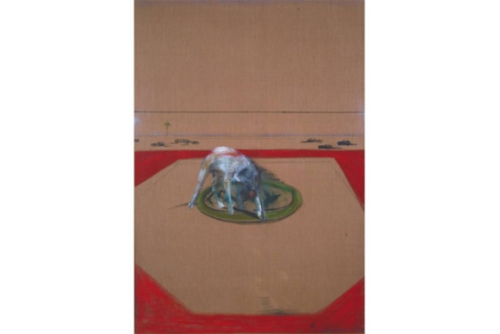
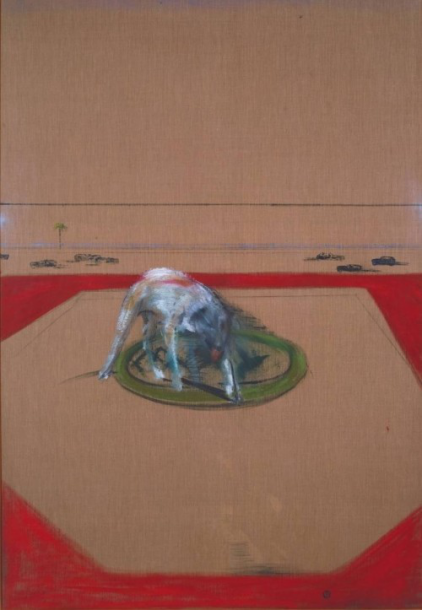
Francis Bacon - Studies of a Dog
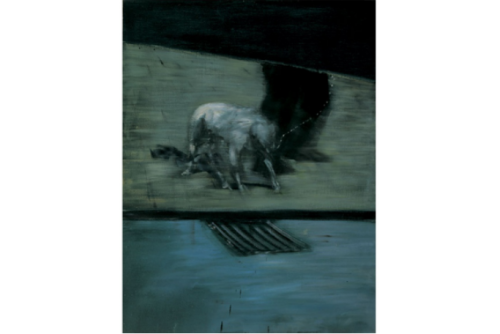
Now, this is going to be a bit of a shocker, coming after Hockney’s tear-jerking dog portraits. But, Bacon will be Bacon and Hockney will be Hockney, and it seems that not all the painters from Britain expressed their emotions with the same sentiment. While Hockney translates his closeness to his dogs in a romantic manner, Bacon observes the dog from a distance, allowing for it to appear as a mysterious stranger with an uncertain character. The dog may be violent, or it may be anxious and vulnerable – we don’t know for sure.Ultimately, the paintings don’t seem to really be about dogs themselves, but probably about what they can represent, chasing their own tales or standing impatiently next to their owners. As Deleuze had suggested, with Bacon, it’s all about the composition of the image: For Bacon the dog is not only centre stage but is, to extend the analogy, the entire play. (on 1952 ‘Study of a Dog’)
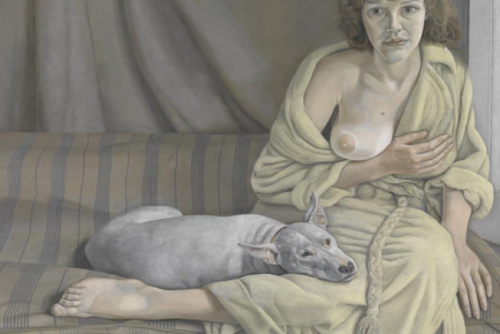
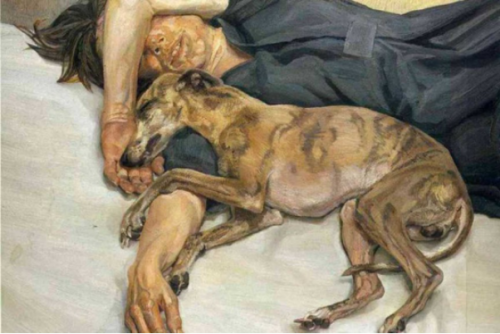
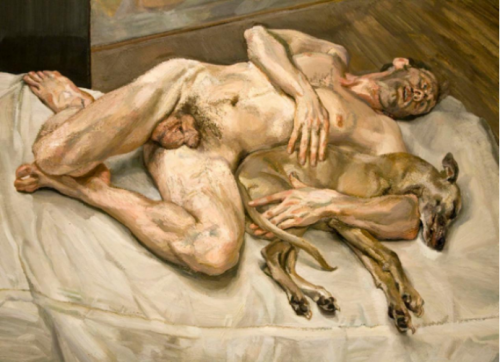
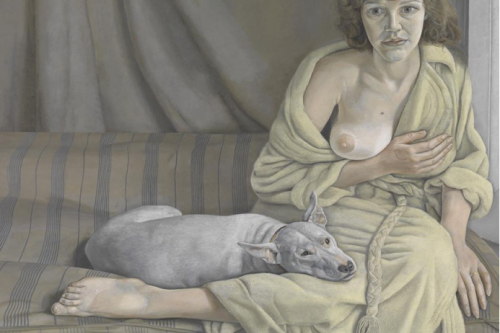
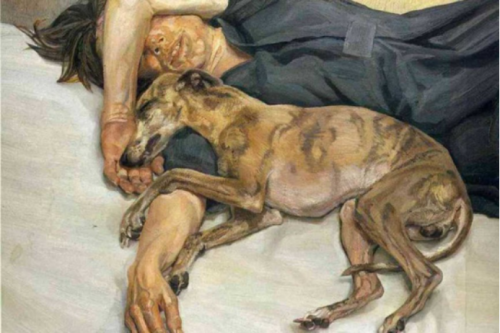
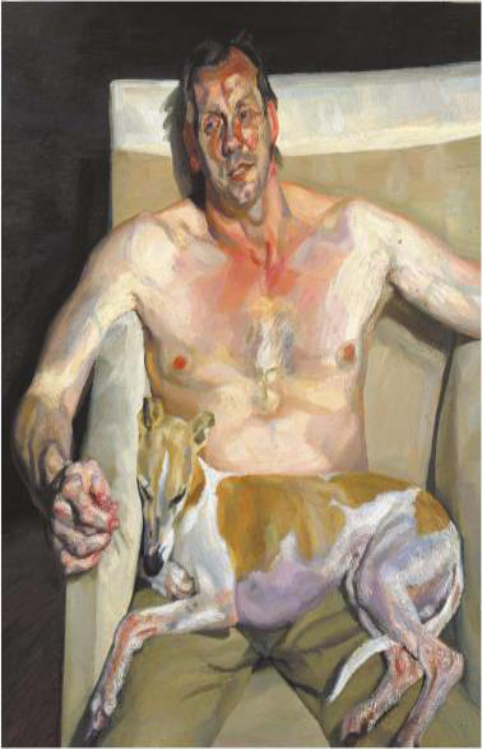
Lucian Freud returned to depicting dogs several times in his long career. One thing that all these paintings have in common is the human presence. Dogs are never portrayed alone, rather always in correlation with a human being. In 1951, the artist made a painting of his pregnant wife, sitting in calm silence, next to a pet dog. The silence presented in this painting is somewhere between loneliness and peacefulness, and it is this loneliness that characterizes most of Freud’s work. However, it seems like the dog makes it possible for the feeling not to gravitate toward either of the two.Freud created a great number of paintings which include dogs later on, and it is always the silence that takes a different form in these artworks. With dogs in the picture, silence always seems to be a way of communicating, rather than an unpleasant lack of sound.
Vera Barnett after Otto Dix
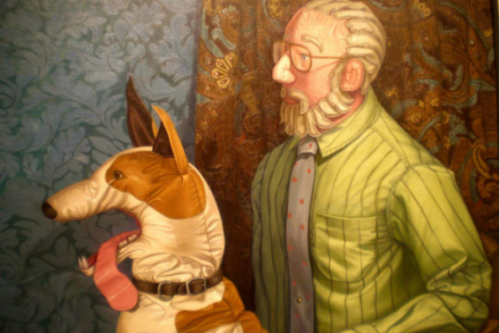
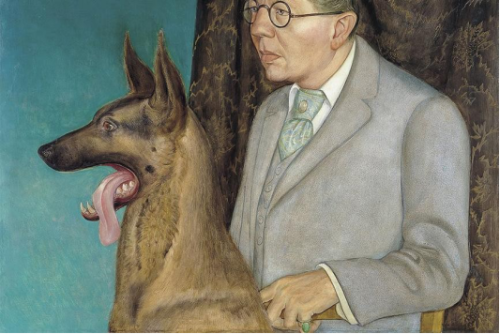
The painting by Vera Barnett is an interpretation of Otto Dix‘s Hugo Erfurth with Dog, made in 1926. Be it because of the inflatable aesthetics, reminiscent of Koons’ puppies, or due to the humorous approach, the painting looks irresistibly postmodern. All of the characters that appear in her artworks have a strange appeal which reminds us of pool toys. Apart from the witty re-makes of popular paintings (and this particular one accidentally includes a dog as well), Barnett often presents domestic animals as toys, which are neither inanimate nor alive. Vera’s version of Dix’s painting is entitled “The artist and his dog”. In both paintings, you gotta love the dog’s goofy tongue, especially in comparison with the seriousness of the owner.
Jean Michel Basquiat - Boy and Dog in a Johnnypump
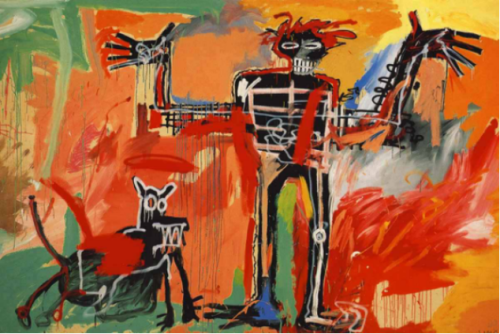
The forever adored and never forgotten Jean-Michel Basquiat made several paintings which incorporate dogs, and I suppose we all know the most famous one. Boy and Dog in a Johnnypump is Basquiat’s work dating from 1982, and according to G. Fernández, it helped Basquiat “reach the zenith of his talent”. The primitive, expressive approach to painting, which is typical for Basquiat’s work, shows a boy and a dog playing, but in a slightly unsettling manner. We’re not actually even sure of what happens in the painting, instead we are left impressed by the raw color and the idiosyncratic style in which both the dog and the boy are depicted.
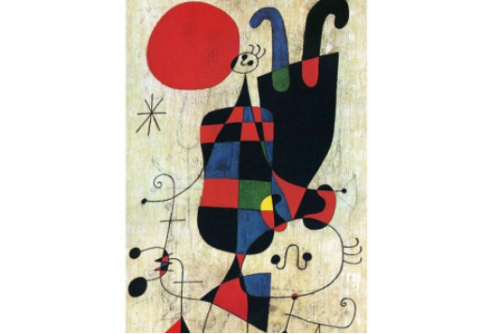
Joan Miro’s Barking Dogs
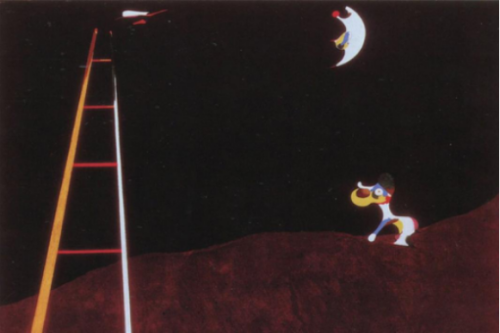
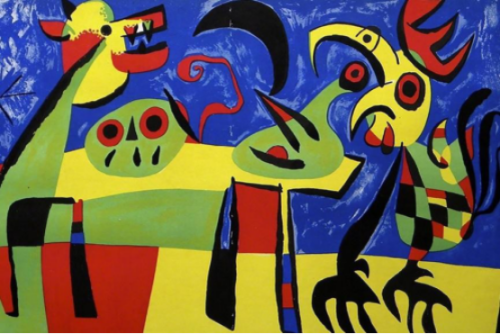
Joan Miro made a few paintings which depict dogs barking at the moon, or standing in front of the sun. But if you know Miro’s work, you probably know that most of us wouldn’t have guessed that there were any dogs in the painting, if there wasn’t for the title. The first one was made in 1926, and it depicts a dog in an eerie, darkish landscape, accompanied by a strange ladder which leads to the sky. In his own, magical way, Miro turns a distorted image into asentimental narrative. Another Dog Barking at the Moon was created in 1952, and it is a litograph, more colorful than the previous one. There’s also Figures and Dog in front of the Sun, made in 1949 – you can see all three in the slider.
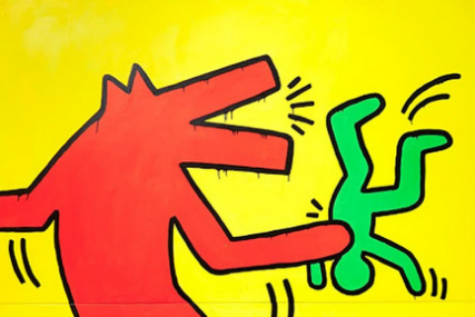
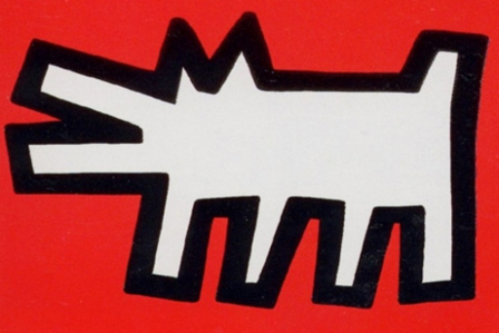
Keith Haring’s Barking Dogs
Keith Haring‘s dogs are barking as well, but the sentiment is less romantic. Haring used his visual symbols as elements of a new language, and it helped him send meaningful messages to the world. A barking dog is a tag which is believed to symbolize power, and sometimes repression, which demands obedience and represents authority. At times, the dogs take on a human form, and molest the human characters which he also used to depict quite often. This human-dog combination brings out the “negative” side of a violent, barking dog. We could have perhaps seen the good side as well, but Haring died young, in 1990. Nevertheless, his symbols are eternal and we can discuss their meaning forever.
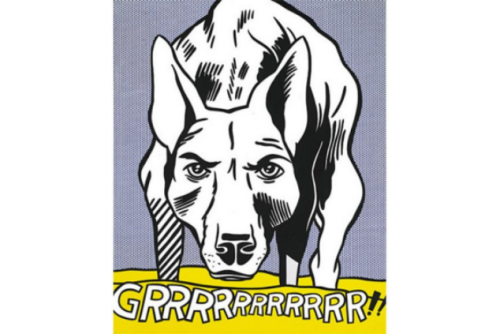
Roy Lichtenstein - Grrrrrrrrrrr!!
Made in Roy Lichtenstein‘s signature style, Grrrrrrrrrrr!! (1965) displays a seemingly angry dog. As usual, the artist used Ben-day dots and black strokes to depict his protagonist. The inspiration came from a comic book, however only a portion of the dog’s face is visible in it, meaning that the dog’s facial expression is Lichtenstein’s original creation. As you can see, the dog’s eyebrows reveal its fury, which is an occurrence you’ll never experience in reality. So once again, the canine is given human traits (even though hes speech bubble doesn’t contain real words).
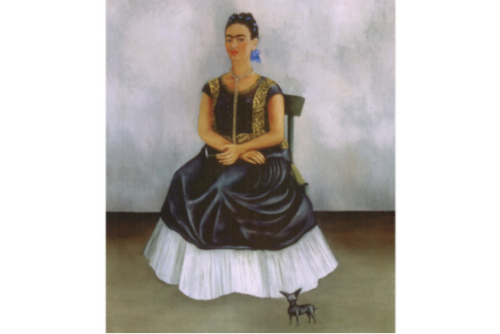
Itzcuintli Dog with Frida Kahlo
As you already know, the famous Mexican painter used to make self-portraits quite often. Every once in a while, these used to involve other characters as well, hummingbirds, monkeys, wounded deer, and – a tiny little dog. Frida Kahlo was photographed with her dogs several times, and these photos are perhaps the most famous of hers. In one of her paintings from 1938, Itzcuintli Dog with Me, Frida depicted a small Mexican dog, standing next to her heavy black dress. Allegedly, dogs represent death in the ancient Mexican culture, but it was never confirmed that Frida had this in mind. A fact is, however, that she often sought comfort in her animals, to compensate the pain caused by her inability to have children. And here’s a bit of trivia: an X-ray discovered another work underneath this painting, which depicts little birds and plants around a lake.
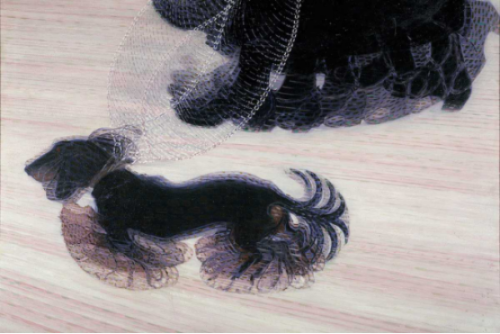
Giacomo Balla - Dynamism of a Dog on a Leash
The idea was to start and finish off this thread with the two most famous examples – one from the end, and one from the beginning of the 20th century. Giacomo Balla‘s futurist painting was created in 1912, and it is probably a painting known by any art student in the world. All the unique “dynamic” aesthetics of futurism aside, the thing that makes this picture so amazing is the framing. The dog is the center of attention as you can see, and his lady owner is in the background. We can only see her feet and her dress, which are banally reminiscent of the dog’s fur and legs. And do notice one more thing and see how we’ve really come full circle – just like in Hockney’s works from the beginning, the dog is a dachshund.
In chapter one of his seminal text Deleuze asserts how Bacon composes the painting as ‘a kind of amphitheatre’, a stage which is used to to ‘isolate the figure’. The analogy of the canvas as a kind of theatre, a space in which drama can be acted out, on or through is hardly new, but Deleuze’s assertion that Bacon uses it specifically to isolate the figure is of interest.
Focus in on Bacon’s construction of theatrical spaces which provide platforms for figures to escape the limitations of narration and illustration. Bacon sets up spaces which, through their claustrophobia and cage like limits have the paradoxical effect of liberating the figures from the suffocating influence of the external narrating components in a painting. A figure tends normally to be in direct engagement with the elements which sit around a canvas, in the perimeters of a stage. It is a dialogue which starts a stream of associations which are inherently narrative. As such we tend to presume that a figures actions, reactions, emotional states and general being are a product of the other component parts of a painting. We presume a painting to be a network of elements which are reveling a series of cause and effects and which potentially point to wider causes and effects outside of the spatial and temporal framework of the image. This is exactly what Bacon’s paintings, and their architectural constructions (all cage like geometric spaces) fight against.
For Bacon painting need not take on other mediums in the game of storytelling. The figure need not be part of a whole, but can be an independent whole which we have to engage with directly and intensely. As Deleuze puts it:
‘Narration is the correlate of illustration. A story always slips into, or tends to slip into, the space between two figures in order to animate the illustrated whole. Isolation is thus the simplest means, necessary but not sufficient, to break with representation, to disrupt narration, to escape illustration, to liberate the Figure: to stick to the fact’
Bacon’s 1952 ‘Study of a Dog’ is a work which perfectly exemplifies this. For Bacon the dog is not only centre stage but is, to extend the analogy, the entire play. It spins and twists violently within itself, a ball of centrifugal force which almost breaks down its form, as if locked somewhere between live self autopsy and slow motion photography. The staging of the piece merely heightens the focus on this internalsied energy. It is a figure and an action which is utterly self reliant.
Kant wrote about the thing in itself. Post Kant writers took this as a launch pad for Romantic discussions over the central existential crisis of modernity, the figure islotated in the universe with no certainty of attachment to anything outside of its own corporeality. Bacon presents us with a Dog which in its disturbing and restless moment in flux gives us this human crisis its most base animal form, a dog chasing its tail as if it were something other, something outside of self to latch onto. It is a process central to his work, to the heighten intensity with which he presents our condition back to us, emptied of the safe opening space of narrative and left locked in the prison of existence.